


Jun-2026 FREE Palo Alto Networks PCNSE PRACTICE QUESTIONS AND ANSWERS UPDATES
DEMO FREE BEFORE YOU BUY PCNSE DUMPS
The PCNSE exam is designed to test the knowledge and skills of security engineers in various areas related to the Palo Alto Networks platform. This includes topics such as firewall configuration, network security, VPN setup, threat prevention, and more. Candidates who pass the PCNSE exam are recognized as experts in the field of network security and are often sought after by organizations looking for skilled professionals to manage their security infrastructure.
NEW QUESTION # 95
A user at an internal system queries the DNS server for their web server with a private IP of 10 250 241 131 in the. The DNS server returns an address of the web server's public address, 200.1.1.10.
In order to reach the web server, which security rule and U-Turn NAT rule must be configured on the firewall?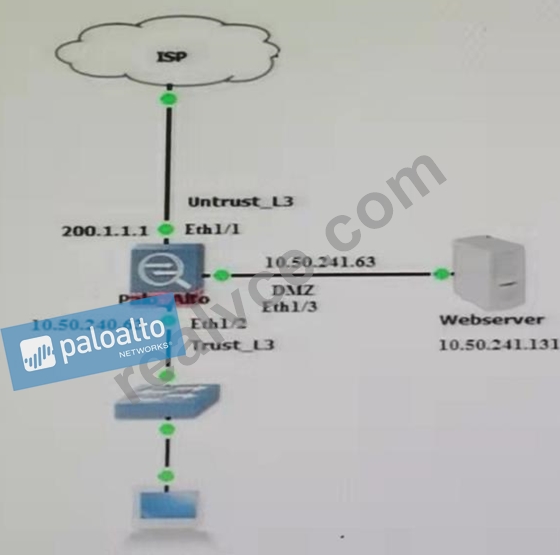
A)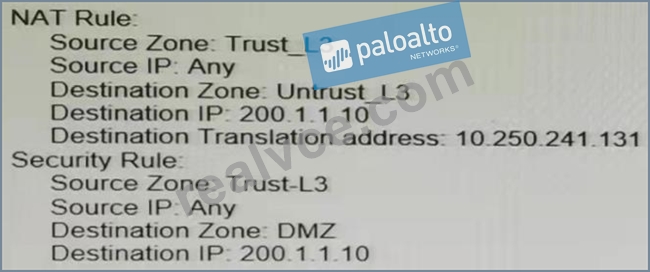
B)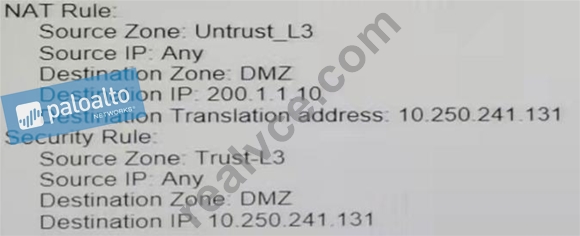
C)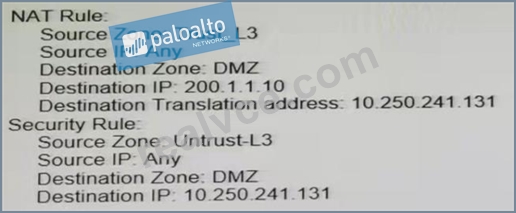
D)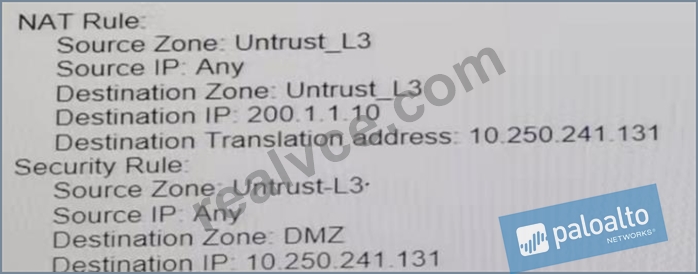
- A. Option D
- B. Option C
- C. Option B
- D. Option A
Answer: D
NEW QUESTION # 96
An administrator has been asked to create 100 virtual firewalls in a local, on-premise lab environment (not
in "the cloud"). Bootstrapping is the most expedient way to perform this task.
Which option describes deployment of a bootstrap package in an on-premise virtual environment?
- A. Use an S3 bucket with an ISO.
- B. Create and attach a virtual hard disk (VHD).
- C. Use config-drive on a USB stick.
- D. Use a virtual CD-ROM with an ISO.
Answer: D
Explanation:
Explanation/Reference:
Reference: https://www.paloaltonetworks.com/documentation/80/virtualization/virtualization/set-up-the-vm-
series-firewall-on-kvm/install-the-vm-series-firewall-on-kvm/use-an-iso-file-to-deploy-the-vm-series-firewall
NEW QUESTION # 97
Which value in the Application column indicates UDP traffic that did not match an App-ID signature?
- A. not-applicable
- B. unknown-ip
- C. incomplete
- D. unknown-udp
Answer: D
Explanation:
Explanation
To safely enable applications you must classify all traffic, across all ports, all the time. With App-ID, the only applications that are typically classified as unknown traffic-tcp, udp or non-syn-tcp-in the ACC and the Traffic logs are commercially available applications that have not yet been added to App-ID, internal or custom applications on your network, or potential threats.
https://docs.paloaltonetworks.com/pan-os/9-0/pan-os-admin/app-id/use-application-objects-in-policy/create-a-cu
NEW QUESTION # 98
A network security engineer for a large company has just installed a PA-5060 Firewall to isolate the company's PCI environment from its production network. The company's engineers made configuration changes to the switches on both network segments, and connected them to the new firewall.
Soon after the cutover, however, users began to complain about latency and some servicers stopped communicating. There are no security policies that deny traffic between the two networks segments. You suspect that there is an interface misconfiguration on Ethernet 1/1.
Which two commands should be used to troubleshoot the issue? (Choose two)
- A. show interface ethernet1/1
- B. show interface logical
- C. show interface hardware
- D. show interface management
Answer: A,B
NEW QUESTION # 99
An administrator wants to prevent users from unintentionally accessing malicious domains where data can be exfiltrated through established connections to remote systems. From the Pre-defined Categories tab within the URL Filtering profile what is the right configuration to prevent such connections?
- A. Set the phishing category to override
- B. Set the hacking category to continue
- C. Set the malware category to block
- D. Set the Command and Control category to block
Answer: D
Explanation:
command-and-control - Command-and-control URLs and domains used by malware and/or compromised systems to surreptitiously communicate with an attacker's remote server to receive malicious commands or exfiltrate data.
https://docs.paloaltonetworks.com/pan-os/10-2/pan-os-admin/url-filtering/url-categories/url- category-best-practices
NEW QUESTION # 100
An administrator wants to upgrade an NGFW from PAN-OS 7 .1. 2 to PAN-OS 8 .0.2 The firewall is not a part of an HA pair. What needs to be updated first?
- A. XML Agent
- B. WildFire
- C. PAN-OS Upgrade Agent
- D. Applications and Threats
Answer: D
NEW QUESTION # 101
An administrator has been asked to configure active/passive HA for a pair of Palo Alto Networks NGFWs.
The administrator assigns priority 100 to the active firewall.
Which priority is correct for the passive firewall?
- A. 0
- B. 1
- C. 2
- D. 3
Answer: C
Explanation:
Reference: https://www.paloaltonetworks.com/content/dam/pan/en_US/assets/pdf/framemaker/71/pan-os/pan- os/section_5.pdf (page 9)
NEW QUESTION # 102
Refer to the exhibit.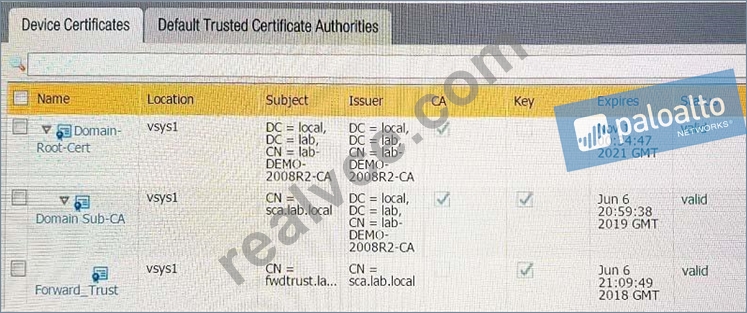
Which certificates can be used as a Forwarded Trust certificate?
- A. Domain Sub-CA
- B. Domain-Root-Cert
- C. Forward_Trust
- D. Certificate from Default Trust Certificate Authorities
Answer: D
NEW QUESTION # 103
A customer wants to set up a site-to-site VPN using tunnel interfaces.
What format is the correct naming convention for tunnel interfaces?
- A. vpn.1024
- B. tun.1025
- C. gre1/2
- D. tunnel.50
Answer: D
NEW QUESTION # 104
The administrator has enabled BGP on a virtual router on the Palo Alto Networks NGFW, but new routes do not seem to be populating the virtual router.
Which two options would help the administrator troubleshoot this issue? (Choose two.)
- A. Perform a traffic pcap on the NGFW to see any BGP problems.
- B. View the Runtime Stats and look for problems with BGP configuration.
- C. View the ACC tab to isolate routing issues.
- D. View the System logs and look for the error messages about BGP.
Answer: B,C
Explanation:
Explanation/Reference:
NEW QUESTION # 105
An administrator is defining protection settings on the Palo Alto Networks NGFW to guard against resource exhaustion. When platform utilization is considered, which steps must the administrator take to configure and apply packet buffer protection?
- A. Create and Apply Zone Protection Profiles in all ingress zones.
Enable Packet Buffer Protection per ingress zone. - B. Configure and apply Zone Protection Profiles for all egress zones.
Enable Packet Buffer Protection pre egress zone. - C. Enable and then configure Packet Buffer thresholds
Enable Interface Buffer protection. - D. Enable and configure the Packet Buffer Protection thresholds.
Enable Packet Buffer Protection per ingress zone. - E. Enable per-vsys Session Threshold alerts and triggers for Packet Buffer Limits.
Enable Zone Buffer Protection per zone.
Answer: D
Explanation:
Explanation/Reference: https://www.paloaltonetworks.com/documentation/80/pan-os/pan-os/zone-protection-and-dos- protection/configure-zone-protection-to-increase-network-security/configure-packet-buffer-protection
NEW QUESTION # 106
An Administrator is configuring an IPSec VPN toa Cisco ASA at the administrator's home and experiencing issues completing the connection. The following is th output from the command: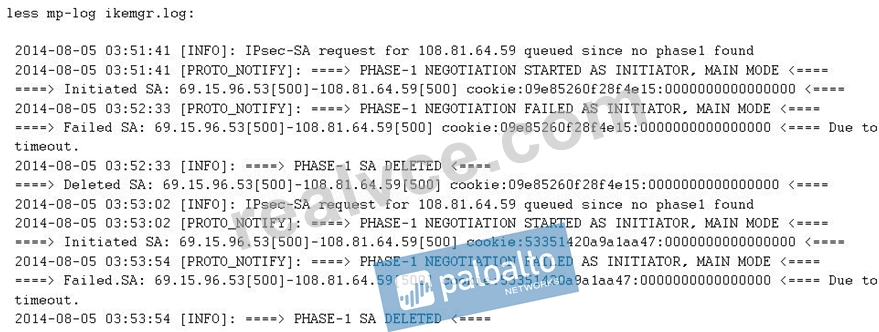
What could be the cause of this problem?
- A. The shared secrets do not match between the Palo Alto firewall and the ASA
- B. The deed peer detection settings do not match between the Palo Alto Networks Firewall and the ASA
- C. The Proxy IDs on the Palo Alto Networks Firewall do not match the settings on the ASA.
- D. The public IP addresses do not match for both the Palo Alto Networks Firewall and the ASA.
Answer: D
Explanation:
https://www.paloaltonetworks.com/documentation/71/pan-os/pan-os/vpns/interpret-vpn-error- messages
NEW QUESTION # 107
Match each GlobalProtect component to the purpose of that component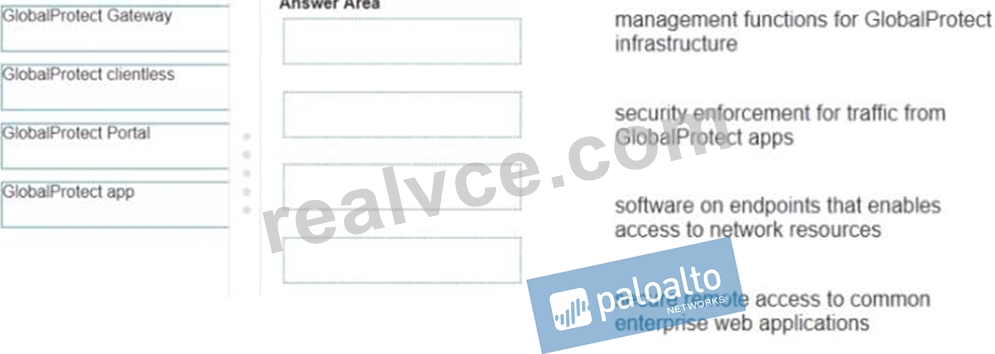
Answer:
Explanation: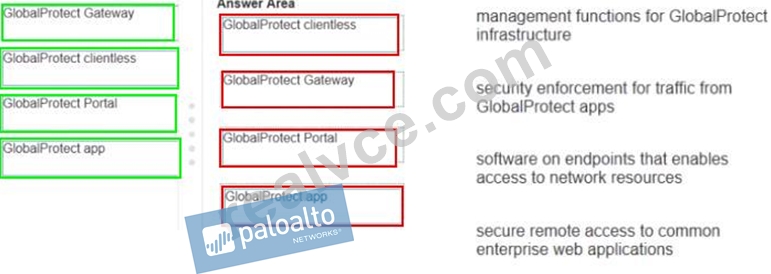
NEW QUESTION # 108
A network administrator wants to deploy SSL Forward Proxy decryption. What two attributes should a forward trust certificate have? (Choose two.)
- A. A subject alternative name
- B. A certificate authority (CA) certificate
- C. A server certificate
- D. A private key
Answer: B,D
Explanation:
The two attributes that a forward trust certificate should have for SSL Forward Proxy decryption are:
* B: A private key. This is the key that the firewall uses to sign the certificates that it generates for the
* decrypted sessions. The private key must be securely stored on the firewall and not shared with anyone1.
* D: A certificate authority (CA) certificate. This is the certificate that the firewall uses to issue the certificates for the decrypted sessions. The CA certificate must be trusted by the client browsers and devices that receive the certificates from the firewall1.
NEW QUESTION # 109
Given the following configuration, which route is used for destination 10.10.0.4?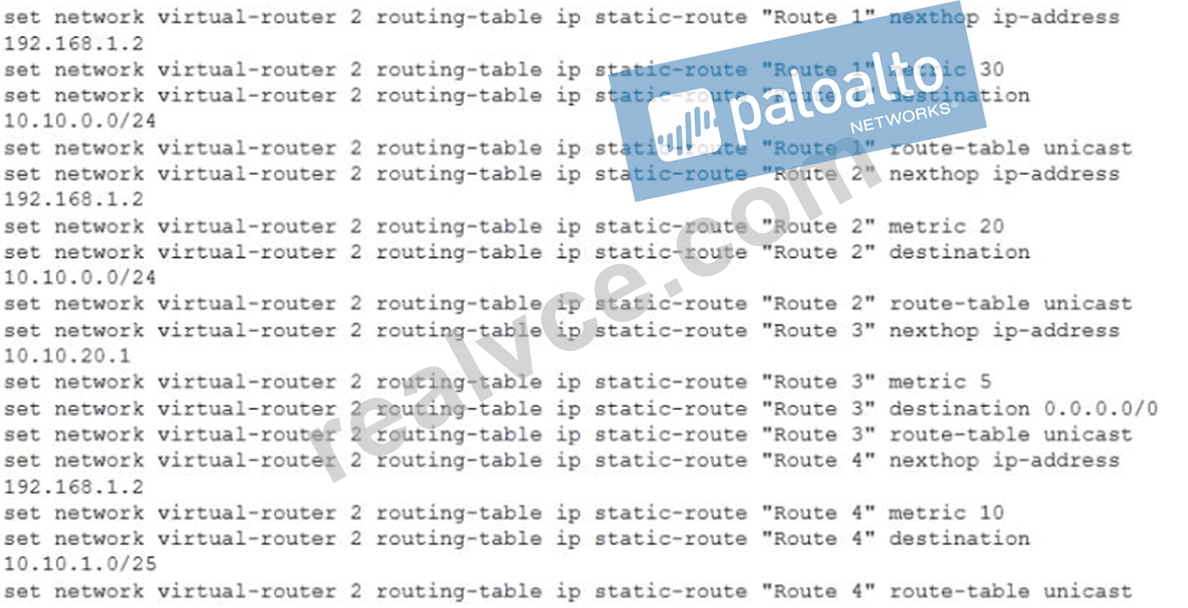
- A. Route 1
- B. Route 3
- C. Route 4
- D. Route 3
Answer: C
NEW QUESTION # 110
Which method will dynamically register tags on the Palo Alto Networks NGFW?
- A. XML API or the VM Monitoring agent on the NGFW or on the User-ID agent
- B. Restful API or the VMware API on the firewall or on the User-ID agent
- C. Restful API or the VMWare API on the firewall or on the User-ID agent or the read-only domain controller (RODC)
- D. XML-API or the VMware API on the firewall or on the User-ID agent or the CLI
Answer: A
Explanation:
Explanation/Reference:
Reference: https://www.paloaltonetworks.com/documentation/80/pan-os/pan-os/policy/register-ip- addresses-and-tags-dynamically
NEW QUESTION # 111
......
Latest Palo Alto Networks PCNSE Dumps with Test Engine and PDF: https://testking.realvce.com/PCNSE-VCE-file.html