


Free Jan-2025 Databricks-Machine-Learning-Associate Dumps are Available for Instant Access
View All Databricks-Machine-Learning-Associate Actual Exam Questions Answers and Explanations for Free
NEW QUESTION # 21
A data scientist has developed a random forest regressor rfr and included it as the final stage in a Spark MLPipeline pipeline. They then set up a cross-validation process with pipeline as the estimator in the following code block: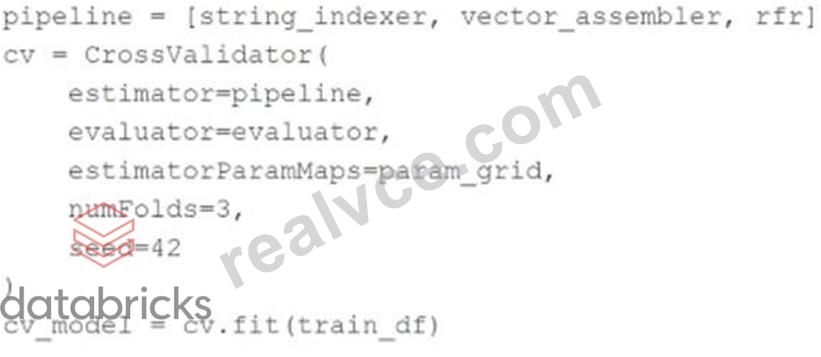
Which of the following is a negative consequence of including pipeline as the estimator in the cross-validation process rather than rfr as the estimator?
- A. The process will leak data prep information from the validation sets to the training sets for each model
- B. The process will leak data from the training set to the test set during the evaluation phase
- C. The process will have a longer runtime because all stages of pipeline need to be refit or retransformed with each mode
- D. The process will be unable to parallelize tuning due to the distributed nature of pipeline
Answer: C
Explanation:
Including the entire pipeline as the estimator in the cross-validation process means that all stages of the pipeline, including data preprocessing steps like string indexing and vector assembling, will be refit or retransformed for each fold of the cross-validation. This results in a longer runtime because each fold requires re-execution of these preprocessing steps, which can be computationally expensive.
If only the random forest regressor (rfr) were included as the estimator, the preprocessing steps would be performed once, and only the model fitting would be repeated for each fold, significantly reducing the computational overhead.
Reference:
Databricks documentation on cross-validation: Cross Validation
NEW QUESTION # 22
A data scientist wants to use Spark ML to impute missing values in their PySpark DataFrame features_df. They want to replace missing values in all numeric columns in features_df with each respective numeric column's median value.
They have developed the following code block to accomplish this task: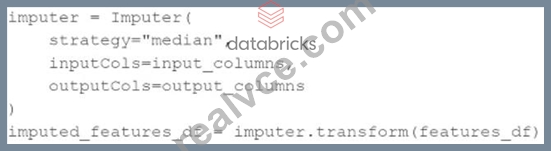
The code block is not accomplishing the task.
Which reasons describes why the code block is not accomplishing the imputation task?
- A. The fit method needs to be called instead of transform.
- B. It does not impute both the training and test data sets.
- C. The inputCols and outputCols need to be exactly the same.
- D. It does not fit the imputer on the data to create an ImputerModel.
Answer: D
Explanation:
In the provided code block, the Imputer object is created but not fitted on the data to generate an ImputerModel. The transform method is being called directly on the Imputer object, which does not yet contain the fitted median values needed for imputation. The correct approach is to fit the imputer on the dataset first.
Corrected code:
imputer = Imputer( strategy="median", inputCols=input_columns, outputCols=output_columns ) imputer_model = imputer.fit(features_df) # Fit the imputer to the data imputed_features_df = imputer_model.transform(features_df) # Transform the data using the fitted imputer Reference:
PySpark ML Documentation
NEW QUESTION # 23
A machine learning engineer is converting a decision tree from sklearn to Spark ML. They notice that they are receiving different results despite all of their data and manually specified hyperparameter values being identical.
Which of the following describes a reason that the single-node sklearn decision tree and the Spark ML decision tree can differ?
- A. Spark ML decision trees automatically prune overfit trees
- B. Spark ML decision trees test more split candidates in the splitting algorithm
- C. Spark ML decision trees test binned features values as representative split candidates
- D. Spark ML decision trees test a random sample of feature variables in the splitting algorithm
- E. Spark ML decision trees test every feature variable in the splitting algorithm
Answer: C
Explanation:
One reason that results can differ between sklearn and Spark ML decision trees, despite identical data and hyperparameters, is that Spark ML decision trees test binned feature values as representative split candidates. Spark ML uses a method called "quantile binning" to reduce the number of potential split points by grouping continuous features into bins. This binning process can lead to different splits compared to sklearn, which tests all possible split points directly. This difference in the splitting algorithm can cause variations in the resulting trees.
Reference:
Spark MLlib Documentation (Decision Trees and Quantile Binning).
NEW QUESTION # 24
A machine learning engineer would like to develop a linear regression model with Spark ML to predict the price of a hotel room. They are using the Spark DataFrame train_df to train the model.
The Spark DataFrame train_df has the following schema:
The machine learning engineer shares the following code block:
Which of the following changes does the machine learning engineer need to make to complete the task?
- A. They need to split the features column out into one column for each feature
- B. They need to call the transform method on train df
- C. They need to utilize a Pipeline to fit the model
- D. They need to convert the features column to be a vector
- E. They do not need to make any changes
Answer: D
Explanation:
In Spark ML, the linear regression model expects the feature column to be a vector type. However, if the features column in the DataFrame train_df is not already in this format (such as being a column of type UDT or a non-vectorized type), the engineer needs to convert it to a vector column using a transformer like VectorAssembler. This is a critical step in preparing the data for modeling as Spark ML models require input features to be combined into a single vector column.
Reference
Spark MLlib documentation for LinearRegression: https://spark.apache.org/docs/latest/ml-classification-regression.html#linear-regression
NEW QUESTION # 25
A machine learning engineer is trying to scale a machine learning pipeline by distributing its single-node model tuning process. After broadcasting the entire training data onto each core, each core in the cluster can train one model at a time. Because the tuning process is still running slowly, the engineer wants to increase the level of parallelism from 4 cores to 8 cores to speed up the tuning process. Unfortunately, the total memory in the cluster cannot be increased.
In which of the following scenarios will increasing the level of parallelism from 4 to 8 speed up the tuning process?
- A. When the data is particularly wide in shape
- B. When the data is particularly long in shape
- C. When the tuning process in randomized
- D. When the model is unable to be parallelized
- E. When the entire data can fit on each core
Answer: E
Explanation:
Increasing the level of parallelism from 4 to 8 cores can speed up the tuning process if each core can handle the entire dataset. This ensures that each core can independently work on training a model without running into memory constraints. If the entire dataset fits into the memory of each core, adding more cores will allow more models to be trained in parallel, thus speeding up the process.
Reference:
Parallel Computing Concepts
NEW QUESTION # 26
A data scientist wants to use Spark ML to one-hot encode the categorical features in their PySpark DataFrame features_df. A list of the names of the string columns is assigned to the input_columns variable.
They have developed this code block to accomplish this task: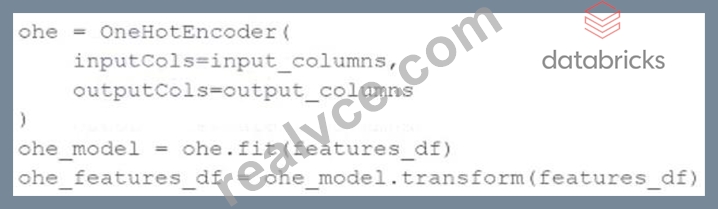
The code block is returning an error.
Which of the following adjustments does the data scientist need to make to accomplish this task?
- A. They need to use Stringlndexer prior to one-hot encodinq the features.
- B. They need to use VectorAssembler prior to one-hot encoding the features.
- C. They need to remove the line with the fit operation.
- D. They need to specify the method parameter to the OneHotEncoder.
Answer: A
Explanation:
The OneHotEncoder in Spark ML requires numerical indices as inputs rather than string labels. Therefore, you need to first convert the string columns to numerical indices using StringIndexer. After that, you can apply OneHotEncoder to these indices.
Corrected code:
from pyspark.ml.feature import StringIndexer, OneHotEncoder # Convert string column to index indexers = [StringIndexer(inputCol=col, outputCol=col+"_index") for col in input_columns] indexer_model = Pipeline(stages=indexers).fit(features_df) indexed_features_df = indexer_model.transform(features_df) # One-hot encode the indexed columns ohe = OneHotEncoder(inputCols=[col+"_index" for col in input_columns], outputCols=output_columns) ohe_model = ohe.fit(indexed_features_df) ohe_features_df = ohe_model.transform(indexed_features_df) Reference:
PySpark ML Documentation
NEW QUESTION # 27
The implementation of linear regression in Spark ML first attempts to solve the linear regression problem using matrix decomposition, but this method does not scale well to large datasets with a large number of variables.
Which of the following approaches does Spark ML use to distribute the training of a linear regression model for large data?
- A. Singular value decomposition
- B. Logistic regression
- C. Spark ML cannot distribute linear regression training
- D. Iterative optimization
- E. Least-squares method
Answer: D
Explanation:
For large datasets with many variables, Spark ML distributes the training of a linear regression model using iterative optimization methods. Specifically, Spark ML employs algorithms such as Gradient Descent or L-BFGS (Limited-memory Broyden-Fletcher-Goldfarb-Shanno) to iteratively minimize the loss function. These iterative methods are suitable for distributed computing environments and can handle large-scale data efficiently by partitioning the data across nodes in a cluster and performing parallel updates.
Reference:
Spark MLlib Documentation (Linear Regression with Iterative Optimization).
NEW QUESTION # 28
A data scientist is developing a single-node machine learning model. They have a large number of model configurations to test as a part of their experiment. As a result, the model tuning process takes too long to complete. Which of the following approaches can be used to speed up the model tuning process?
- A. Enable autoscaling clusters
- B. Scale up with Spark ML
- C. Implement MLflow Experiment Tracking
- D. Parallelize with Hyperopt
Answer: D
Explanation:
To speed up the model tuning process when dealing with a large number of model configurations, parallelizing the hyperparameter search using Hyperopt is an effective approach. Hyperopt provides tools like SparkTrials which can run hyperparameter optimization in parallel across a Spark cluster.
Example:
from hyperopt import fmin, tpe, hp, SparkTrials search_space = { 'x': hp.uniform('x', 0, 1), 'y': hp.uniform('y', 0, 1) } def objective(params): return params['x'] ** 2 + params['y'] ** 2 spark_trials = SparkTrials(parallelism=4) best = fmin(fn=objective, space=search_space, algo=tpe.suggest, max_evals=100, trials=spark_trials) Reference:
Hyperopt Documentation
NEW QUESTION # 29
A data scientist learned during their training to always use 5-fold cross-validation in their model development workflow. A colleague suggests that there are cases where a train-validation split could be preferred over k-fold cross-validation when k > 2.
Which of the following describes a potential benefit of using a train-validation split over k-fold cross-validation in this scenario?
- A. Reproducibility is achievable when using a train-validation split
- B. Fewer hyperparameter values need to be tested when using a train-validation split
- C. A holdout set is not necessary when using a train-validation split
- D. Fewer models need to be trained when using a train-validation split
- E. Bias is avoidable when using a train-validation split
Answer: D
NEW QUESTION # 30
A machine learning engineer is trying to scale a machine learning pipeline by distributing its feature engineering process.
Which of the following feature engineering tasks will be the least efficient to distribute?
- A. Imputing missing feature values with the mean
- B. Target encoding categorical features
- C. One-hot encoding categorical features
- D. Creating binary indicator features for missing values
- E. Imputing missing feature values with the true median
Answer: E
Explanation:
Among the options listed, calculating the true median for imputing missing feature values is the least efficient to distribute. This is because the true median requires knowledge of the entire data distribution, which can be computationally expensive in a distributed environment. Unlike mean or mode, finding the median requires sorting the data or maintaining a full distribution, which is more intensive and often requires shuffling the data across partitions.
Reference
Challenges in parallel processing and distributed computing for data aggregation like median calculation: https://www.apache.org
NEW QUESTION # 31
A data scientist has created two linear regression models. The first model uses price as a label variable and the second model uses log(price) as a label variable. When evaluating the RMSE of each model by comparing the label predictions to the actual price values, the data scientist notices that the RMSE for the second model is much larger than the RMSE of the first model.
Which of the following possible explanations for this difference is invalid?
- A. The RMSE is an invalid evaluation metric for regression problems
- B. The data scientist failed to exponentiate the predictions in the second model prior to computing the RMSE
- C. The second model is much more accurate than the first model
- D. The first model is much more accurate than the second model
- E. The data scientist failed to take the log of the predictions in the first model prior to computing the RMSE
Answer: A
Explanation:
The Root Mean Squared Error (RMSE) is a standard and widely used metric for evaluating the accuracy of regression models. The statement that it is invalid is incorrect. Here's a breakdown of why the other statements are or are not valid:
Transformations and RMSE Calculation: If the model predictions were transformed (e.g., using log), they should be converted back to their original scale before calculating RMSE to ensure accuracy in the evaluation. Missteps in this conversion process can lead to misleading RMSE values.
Accuracy of Models: Without additional information, we can't definitively say which model is more accurate without considering their RMSE values properly scaled back to the original price scale.
Appropriateness of RMSE: RMSE is entirely valid for regression problems as it provides a measure of how accurately a model predicts the outcome, expressed in the same units as the dependent variable.
Reference
"Applied Predictive Modeling" by Max Kuhn and Kjell Johnson (Springer, 2013), particularly the chapters discussing model evaluation metrics.
NEW QUESTION # 32
A data scientist is developing a machine learning pipeline using AutoML on Databricks Machine Learning.
Which of the following steps will the data scientist need to perform outside of their AutoML experiment?
- A. Model evaluation
- B. Model deployment
- C. Exploratory data analysis
- D. Model tuning
Answer: C
Explanation:
AutoML platforms, such as the one available in Databricks Machine Learning, streamline various stages of the machine learning pipeline including feature engineering, model selection, hyperparameter tuning, and model evaluation. However, exploratory data analysis (EDA) is typically performed outside the AutoML process. EDA involves understanding the dataset, visualizing distributions, identifying anomalies, and gaining insights into data before feeding it into a machine learning pipeline. This step is crucial for ensuring that the data is clean and suitable for model training but is generally done manually by the data scientist.
Reference
Databricks documentation on AutoML: https://docs.databricks.com/applications/machine-learning/automl.html
NEW QUESTION # 33
A data scientist wants to tune a set of hyperparameters for a machine learning model. They have wrapped a Spark ML model in the objective function objective_function and they have defined the search space search_space.
As a result, they have the following code block: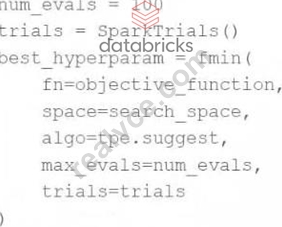
Which of the following changes do they need to make to the above code block in order to accomplish the task?
- A. Remove the trials=trials argument
- B. Remove the algo=tpe.suggest argument
- C. Change SparkTrials() to Trials()
- D. Reduce num_evals to be less than 10
- E. Change fmin() to fmax()
Answer: C
Explanation:
The SparkTrials() is used to distribute trials of hyperparameter tuning across a Spark cluster. If the environment does not support Spark or if the user prefers not to use distributed computing for this purpose, switching to Trials() would be appropriate. Trials() is the standard class for managing search trials in Hyperopt but does not distribute the computation. If the user is encountering issues with SparkTrials() possibly due to an unsupported configuration or an error in the cluster setup, using Trials() can be a suitable change for running the optimization locally or in a non-distributed manner.
Reference
Hyperopt documentation: http://hyperopt.github.io/hyperopt/
NEW QUESTION # 34
A data scientist has written a data cleaning notebook that utilizes the pandas library, but their colleague has suggested that they refactor their notebook to scale with big data.
Which of the following approaches can the data scientist take to spend the least amount of time refactoring their notebook to scale with big data?
- A. They can refactor their notebook to use Spark SQL.
- B. They can refactor their notebook to use the PySpark DataFrame API.
- C. They can refactor their notebook to process the data in parallel.
- D. They can refactor their notebook to use the Scala Dataset API.
- E. They can refactor their notebook to utilize the pandas API on Spark.
Answer: E
Explanation:
The data scientist can refactor their notebook to utilize the pandas API on Spark (now known as pandas on Spark, formerly Koalas). This allows for the least amount of changes to the existing pandas-based code while scaling to handle big data using Spark's distributed computing capabilities. pandas on Spark provides a similar API to pandas, making the transition smoother and faster compared to completely rewriting the code to use PySpark DataFrame API, Scala Dataset API, or Spark SQL.
Reference:
Databricks documentation on pandas API on Spark (formerly Koalas).
NEW QUESTION # 35
A data scientist has developed a linear regression model using Spark ML and computed the predictions in a Spark DataFrame preds_df with the following schema:
prediction DOUBLE
actual DOUBLE
Which of the following code blocks can be used to compute the root mean-squared-error of the model according to the data in preds_df and assign it to the rmse variable?
- A.
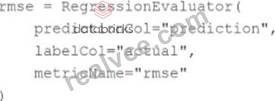
- B.
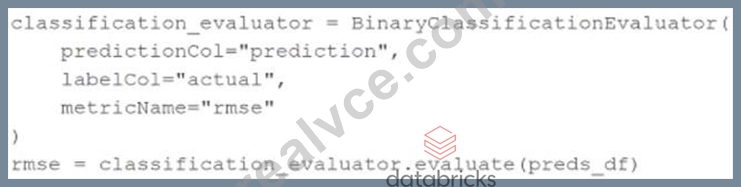
- C.
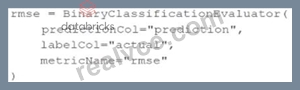
- D.
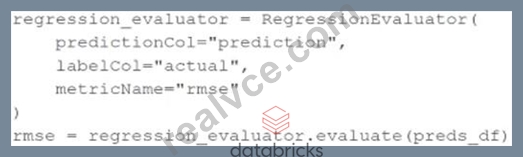
Answer: D
Explanation:
To compute the root mean-squared-error (RMSE) of a linear regression model using Spark ML, the RegressionEvaluator class is used. The RegressionEvaluator is specifically designed for regression tasks and can calculate various metrics, including RMSE, based on the columns containing predictions and actual values.
The correct code block to compute RMSE from the preds_df DataFrame is:
regression_evaluator = RegressionEvaluator( predictionCol="prediction", labelCol="actual", metricName="rmse" ) rmse = regression_evaluator.evaluate(preds_df) This code creates an instance of RegressionEvaluator, specifying the prediction and label columns, as well as the metric to be computed ("rmse"). It then evaluates the predictions in preds_df and assigns the resulting RMSE value to the rmse variable.
Options A and B incorrectly use BinaryClassificationEvaluator, which is not suitable for regression tasks. Option D also incorrectly uses BinaryClassificationEvaluator.
Reference:
PySpark ML Documentation
NEW QUESTION # 36
......
The Most In-Demand Databricks-Machine-Learning-Associate Pass Guaranteed Quiz : https://testking.realvce.com/Databricks-Machine-Learning-Associate-VCE-file.html