


Verified FAR dumps Q&As - Pass Guarantee Exam Dumps Test Engine [2023]
FAR dumps and 165 unique questions
NEW QUESTION 67
On November 1, 20X2, Smith Co. contracted to dispose of an industry segment. Throughout 20X2 the
segment had operating losses. These losses were expected to continue until the segment's disposition.
If a loss is projected on final disposition, how much of the operating losses should be included in the loss
from discontinued operations reported in Smith's 20X2 income statement?
I. Operating losses for the period January 1 to October 31, 20X2.
II. Operating losses for the period November 1 to December 31, 20X2.
III. Estimated operating losses for the period January 1 to February 28, 20X3.
- A. II and III only.
- B. I and III only.
- C. II only.
- D. I and II only.
Answer: D
Explanation:
Choice "d" is correct. The operating losses to be included in Smith's 20X2 income statement would be the
total 20X2 operating losses, regardless of whether those losses occurred before or after the date the
decision to dispose of the component was made, and not any 20X3 operating losses. Projected operating
losses are not anticipated and accrued. Choice "a" is incorrect. The operating losses to be included in
Smith's 20X2 income statement would be the total 20X2 operating losses, regardless of whether those
losses occurred before or after the date the decision to dispose of the component was made, and not any
2 0X3 operating losses. Choice "b" is incorrect. The operating losses to be included in Smith's 20X2
income statement would be the total 20X2 operating losses, regardless of whether those losses occurred
before or after the date the decision to dispose of the component was made, and not any 20X3 operating
losses. Choice "c" is incorrect. The operating losses to be included in Smith's 20X2 income statement
would be the total 20X2 operating losses, regardless of whether those losses occurred before or after the
date the decision to dispose of the component was made, and not any 20X3 operating losses.
NEW QUESTION 68
Opto Co. is a publicly-traded, consolidated enterprise reporting segment information. Which of the
following items is a required enterprise-wide disclosure regarding external customers?
- A. The identity of any external customer considered to be "major" by management.
- B. Information on major customers is not required in segment reporting.
- C. The identity of any external customer providing 10% or more of a particular operating segment's
revenue. - D. The fact that transactions with a particular external customer constitute more than 10% of the total
enterprise revenues.
Answer: D
Explanation:
Choice "a" is correct. In order to conform to GAAP, financial statements for public business enterprises
must report segment information about a company's major customers if that customer provides 10% or
more of the combined revenue, internal and external, of all operating segments.
Choice "b" is incorrect. Revenue is 10% of ALL operating segments not "a particular" segment.
Choice "c" is incorrect. Disclosure is not at management's discretion.
Choice "d" is incorrect. Disclosure is required.
NEW QUESTION 69
On January 2, 1993, Quo, Inc. hired Reed to be its controller. During the year, Reed, working closely with
Quo's president and outside accountants, made changes in accounting policies, corrected several errors
dating from 1992 and before, and instituted new accounting policies.
Quo's 1993 financial statements will be presented in comparative form with its 1992 financial statements.
This question represents one of Quo's transactions. List B represents the general accounting treatment
required for these transactions. These treatments are:
. Cumulative effect approach - Include the cumulative effect of the adjustment resulting from the
accounting change or error correction in the 1993 financial statements, and do not restate the 1992
financial statements.
. Retroactive or retrospective restatement approach - Restate the 1992 financial statements and adjust
1 992 beginning retained earnings if the error or change affects a period prior to 1992.
. Prospective approach - Report 1993 and future financial statements on the new basis but do not restate
1 992 financial statements.
Item to Be Answered
The equipment that Quo manufactures is sold with a five-year warranty. Because of a production
breakthrough, Quo reduced its computation of warranty costs from 3% of sales to 1% of sales.
List B (Select one)
- A. Prospective approach.
- B. Cumulative effect approach.
- C. Retroactive or retrospective restatement approach.
Answer: A
Explanation:
Choice "C" is correct. This affects only the prospective (current and subsequent) periods - not prior
periods, not retained earnings.
NEW QUESTION 70
According to the FASB conceptual framework, which of the following attributes would not be used to
measure inventory?
- A. Historical cost.
- B. Present value of future cash flows.
- C. Net realizable value.
- D. Replacement cost.
Answer: B
Explanation:
Choice "d" is correct. The present value of future cash flows is used to measure long-term receivables or
payables, not inventory, because inventory is a short-term asset, which has more immediate cash flows.
SFAC 5 para. 67 Choice "a" is incorrect. Historical cost can be used to measure inventory because it is a
relevant and reliable measurement attribute of current assets such as inventory. Choice "b" is incorrect.
Replacement (or current) cost can be used to measure inventory because it is a relevant and reliable
measurement attribute of current assets such as inventory. Choice "c" is incorrect. Net realizable value
can be used to measure inventory because it is a relevant and reliable measurement attribute of current
assets such as inventory.
NEW QUESTION 71
While preparing its 1991 financial statements, Dek Corp. discovered computational errors in its 1990 and
1 989 depreciation expense. These errors resulted in overstatement of each year's income by $25,000,
net of income taxes. The following amounts were reported in the previously issued financial statements:
Dek's 1991 net income is correctly reported at $180,000. Which of the following amounts should be
reported as prior period adjustments and net income in Dek's 1991 and 1990 comparative financial
statements?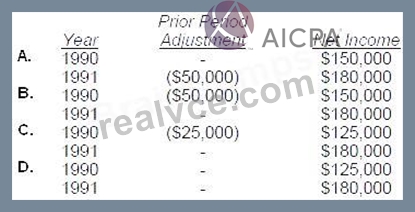
- A. Option A
- B. Option B
- C. Option D
- D. Option C
Answer: D
Explanation:
Choice "c" is correct. 1990 ($25,000) $125,000 1991 -- 180,000
Because these are comparative financial statements, prior period adjustments require retroactive
treatment for the years presented. Because 1989 is not presented, the 1989 correction is shown as a prior
period adjustment of $25,000 to retained earnings statement of 1990.
NEW QUESTION 72
There are multiple active markets for a financial asset with different observable market prices:
There is no principal market for the financial asset. What is the fair value of the asset?
- A. $71
- B. $76
- C. $72
- D. $74
Answer: D
Explanation:
Choice "c" is correct. When there is no principal market, the price in the most advantageous market is the
fair value measurement. Although transaction costs are not included in the fair value measurement, they
are used to determine the most advantageous market, as follows:
Market A: Net Price = Quoted Price - Transaction Costs = $76 - 5 = $71 Market B: Net Price = Quoted
Price - Transaction Costs = $74 - 2 = $72
Because the net price in Market B is higher than the net price in Market A, Market B is the most
advantageous market and the quoted price in Market B ($74) is the fair value of the asset. Choice "a" is incorrect.
This is the net price in Market A.
Fair value does not include transaction costs. Choice "b" is incorrect. This is the net price in Market B.
This net price indicates that Market B is the most
advantageous market, but the net price is not the fair value because fair value does not include
transaction costs. Choice "d" is incorrect. If Market A were the principal market for the asset, then this
would be the fair value of the asset. However, because there is no principal market, the price in the most
advantageous market (Market B) is the price of the asset.
NEW QUESTION 73
An inventory loss from a permanent market decline of $360,000 occurred in May 1989. Cox Co.
appropriately recorded this loss in May 1989 after its March 31, 1989 quarterly report was issued. What
amount of inventory loss should be reported in Cox's quarterly income statement for the three months
ended June 30, 1989?
- A. $360,000
- B. $0
- C. $90,000
- D. $180,000
Answer: A
Explanation:
Choice "d" is correct. $360,000 inventory loss reported for the quarter ended 6-30-89.
Rule: Inventory losses from "permanent market declines" are recognized in the interim period, incurred
and later, if they "turn-around," are recognized as gains in a subsequent interim period only to the extent
of previously reported losses.
Rule: "Temporary" market declines need not be recognized at interim when a "turn-around" can
reasonably be expected to occur before the end of the fiscal year.
Facts: This $360,000 inventory decline is permanent and the entire loss would be recognized in the
quarter interim period incurred (6-30-89).
NEW QUESTION 74
On January 2, 20X5, to better reflect the variable use of its only machine, Holly, Inc. elected to change its
method of depreciation from the straight-line method to the units of production method. The original cost
of the machine on January 2, 20X3, was $50,000, and its estimated life was 10 years. Holly estimates that
the machine's total life is 50,000 machine hours. Machine hours usage was 8,500 during 20X4 and 3,500
during 20X3.
Holly's income tax rate is 30%. Holly should report the accounting change in its 20X5 financial statements
as a(n):
- A. Cumulative effect of a change in accounting principle of $1,400 in its income statement.
- B. None of the above.
- C. Cumulative effect of a change in accounting principle of $2,000 in its income statement.
- D. Adjustment to beginning retained earnings of $2,000.
Answer: B
Explanation:
Choice "d" is correct. A change in the method of depreciation is now considered to be both a change in
method and a change in estimate. These changes should be accounted for as changes in estimate and
handled prospectively. The new depreciation method should be used as of the beginning of the year of
change and should start with the current book value of the underlying asset. No retroactive or
retrospective calculations should be made, and no adjustment should be made to retained earnings. The
cumulative effect treatment on the income statement was the treatment of most changes in accounting
principle prior to SFAS No. 154. The adjustment to beginning retained earnings is the treatment now
given to changes in accounting principle by SFAS No. 154. However a change in depreciation method is
no longer accounted for as a change in accounting principle. Choices "a", "b", and "c" are incorrect, per
the above Explanation: .
NEW QUESTION 75
In general, an enterprise preparing interim financial statements should:
- A. Use the same accounting principles followed in preparing its latest annual financial statements.
- B. Defer recognition of seasonal revenue.
- C. Allocate revenues and expenses evenly over the quarters, regardless of when they actually occurred.
- D. Disregard permanent decreases in the market value of its inventory.
Answer: A
Explanation:
Choice "d" is correct. Generally accepted accounting principles that were used in the most recent annual
report of an enterprise should be applied to interim financial statements of the current year, unless a
change in accounting principle is adopted in the current year.
Choices "a", "b", and "c" are incorrect, per above.
NEW QUESTION 76
The summary of significant accounting policies should disclose the:
- A. Terms for convertible debt to be exchanged for common stock.
- B. Criteria for determining which investments are treated as cash equivalents.
- C. Concentration of credit risk of all financial instruments by geographical region.
- D. Maturity dates of noncurrent debts.
Answer: B
Explanation:
Choice "d" is correct. The criteria for determining which investments are treated as cash equivalents
would be part of the summary of significant accounting policies. Choice "a" is incorrect. The maturity
dates of noncurrent debts are required disclosures, but are not a part of the summary of significant
accounting policies. Choice "b" is incorrect. The terms for convertible debt to be exchanged for common
stock are not accounting policies; they would be disclosed separately. Choice "c" is incorrect. The
concentration of credit risk of all financial instruments by geographic region may be a required segment
disclosure, especially for financial institutions. However, it would not be a part of the summary of
significant accounting policies.
NEW QUESTION 77
According to the FASB conceptual framework, the process of reporting an item in the financial statements
of an entity is:
- A. Allocation.
- B. Realization.
- C. Matching.
- D. Recognition.
Answer: D
Explanation:
Choice "d" is correct. Recognition is the process of recording an item in the financial statements of an
entity. SFAC 5 para. 6 Choice "a" is incorrect. Allocation is the accounting process of assigning or
distributing an amount according to a plan or a formulA. SFAC 6 para. 142 Choice "b" is incorrect.
Matching of costs and revenues is simultaneous or combined recognition of the revenues and expenses
that result directly and jointly from the same transactions or other events. SFAC 6 para. 146 Choice "c" is
incorrect. Realization is the process of converting noncash resources and rights into money. SFAC 6 para.
1 43
NEW QUESTION 78
A transaction that is unusual in nature and infrequent in occurrence should be reported separately as a
component of income:
- A. After discontinued operations of a segment of a business.
- B. After cumulative effect of accounting changes and before discontinued operations of a segment of a
business. - C. After cumulative effect of accounting changes and after discontinued operations of a segment of a
business. - D. Before cumulative effect of accounting changes and before discontinued operations of a segment of a
business.
Answer: A
Explanation:
Choice "d" is correct. An extraordinary item (a transaction that is both "unusual in nature" and "infrequent
in occurrence") should be reported separately as a component of income after discontinued operations of
a segment of a business.
The cumulative effect of a change in accounting principle is shown on the retained earnings statement.
This is why memorizing the mnemonic "idea" is so important.
NEW QUESTION 79
Gown, Inc. sold a warehouse and used the proceeds to acquire a new warehouse. The excess of the
proceeds over the carrying amount of the warehouse sold should be reported as a(an):
- A. Part of continuing operations.
- B. Reduction of the cost of the new warehouse.
- C. Gain from discontinued operations, net of income taxes.
- D. Extraordinary gain, net of income taxes.
Answer: A
Explanation:
Choice "b" is correct. Part of continuing operations.
Rule: When a fixed asset is sold, gain or loss is recognized as part of income from continuing operations.
The amount of the gain or loss is equal to the difference between the proceeds from the sale and the
carrying amount (FMV) of the fixed asset sold.
Choice "a" is incorrect. The gain is not extraordinary and is shown gross - not net of tax.
Choice "c" is incorrect. The gain is part of continuing operations - not discontinued operations.
Choice "d" is incorrect. The gain is not reported as a reduction of the cost of the new warehouse.
NEW QUESTION 80
On January 2, 1993, Quo, Inc. hired Reed to be its controller. During the year, Reed, working closely with
Quo's president and outside accountants, made changes in accounting policies, corrected several errors
dating from 1992 and before, and instituted new accounting policies.
Quo's 1993 financial statements will be presented in comparative form with its 1992 financial statements.
This question represents one of Quo's transactions. List B represents the general accounting treatment
required for these transactions. These treatments are:
. Cumulative effect approach - Include the cumulative effect of the adjustment resulting from the
accounting change or error correction in the 1993 financial statements, and do not restate the 1992
financial statements.
. Retroactive or retrospective restatement approach - Restate the 1992 financial statements and adjust
1 992 beginning retained earnings if the error or change affects a period prior to 1992.
. Prospective approach - Report 1993 and future financial statements on the new basis but do not restate
1 992 financial statements.
Item to Be Answered
Quo changed from LIFO to FIFO to account for its finished goods inventory.
List B (Select one)
- A. Cumulative effect approach.
- B. Retroactive or retrospective restatement approach.
- C. Prospective approach.
Answer: B
Explanation:
Choice "B" is correct. A change in accounting principle should be shown in the retained earnings
statement of the earliest year presented as an adjustment of the beginning balance. All prior year financial
statements are recast.
NEW QUESTION 81
Which of the following is a generally accepted accounting principle that illustrates the practice of
conservatism during a particular reporting period?
- A. Reporting inventory at the lower of cost or market value.
- B. Accrual of a contingency deemed to be reasonably possible.
- C. Reporting investments with appreciated market values at market value.
- D. Capitalization of research and development costs.
Answer: A
Explanation:
Choice "d" is correct. The rule of conservatism states that revenues and gains should be recognized when
the earnings process is complete, but that expenses and losses should be expensed immediately.
Reporting inventory at the lower of cost or market requires the recording of a loss on inventory when
market is lower than cost in the period the loss is sustained, rather than when the inventory is sold,
consistent with the rule of conservatism. Choice "a" is incorrect. Because the future benefits of R&D costs
are questionable, these cost should be expensed immediately, consistent with the rule of conservatism
and the matching principle. Choice "b" is incorrect. The rule of conservatism only requires the accrual of
"probable" losses. The accrual of a reasonably possible loss is not required and the accrual of any
contingent gain, whether probable, reasonably possible, or remote, is prohibited. Choice "c" is incorrect.
The reporting of marketable securities with appreciated values at market value requires the recording of a
gain on the asset before the gain is realized. This contradicts the rule of conservatism, but is allowed
because fair value is a more relevant measure of the value of marketable securities.
NEW QUESTION 82
In the hierarchy of generally accepted accounting principles, APB Opinions have the same authority as
AICPA:
- A. Issues Papers.
- B. Accounting Research Bulletins.
- C. Industry Audit and Accounting Guides.
- D. Statements of Position.
Answer: B
Explanation:
Choice "d" is correct. AICPA Accounting Research Bulletins, FASB Standards, FASB Interpretations,
FASB Staff Positions, FASB Statement 133 Implementation Issues, and APB Opinions and
Interpretations are the most authoritative sources of generally accepted accounting principles. Choice "a"
is incorrect. AICPA Statements of Position, AICPA Accounting and Auditing Guides, and FASB Technical
Bulletins are secondary sources of generally accepted accounting principles. Choice "b" is incorrect.
AICPA Statements of Position, AICPA Accounting and Auditing Guides, and FASB Technical Bulletins
are secondary sources of generally accepted accounting principles. Choice "c" is incorrect. AICPA Issues
Papers and Practice Bulletins, FASB Concepts Statements, and other authoritative pronouncements are
tertiary sources for generally accepted accounting principles.
NEW QUESTION 83
Dean Co. acquired 100% of Morey Corp. prior to 1989. During 1989, the individual companies included in
their financial statements the following:
What amount should be reported as related party disclosures in the notes to Dean's 1989 consolidated
financial statements?
- A. $330,000
- B. $155,000
- C. $175,000
- D. $150,000
Answer: C
Explanation:
Choice "c" is correct. The only related party transaction that would require disclosure (assuming that all
amounts are material to the financial statements) would be the loans to officers since they are outside of
the ordinary course of business. Choices "a", "b", and "d" are incorrect. Officers' salaries, officers'
expenses and intercompany sales (between entities included in a consolidated set of financial statements)
are all transactions in the ordinary course of business and generally would not require disclosure.
NEW QUESTION 84
During 1990, Fuqua Steel Co. had the following unusual financial events occur:
. Bonds payable were retired five years before their scheduled maturity, resulting in a $260,000 gain.
Fuqua has frequently retired bonds early when interest rates declined significantly.
. A steel forming segment suffered $255,000 in losses due to hurricane damage. This was the fourth
similar loss sustained in a 5-year period at that location.
. A component of Fuqua's operations, steel transportation, was sold at a net loss of $350,000.
This was Fuqua's first divestiture of one of its operating segments.
Before income taxes, what amount should be disclosed as the gain (loss) from extraordinary items in
1 990?
- A. $5,000
- B. $(350,000)
- C. $(90,000)
- D. $0
Answer: D
Explanation:
Choice "a" is correct. $0. Note: The sale of the steel transportation component resulted in a loss from
discontinued operations and is reported after "income from continuing operations." The steel forming
segment's hurricane damage (4th in 5 years) of $255,000 is only "unusual in nature" and does not occur
infrequently, therefore, it is not an "extraordinary item," and should be reported separately as a
component of "income from continuing operations." The retirement of debt, although unusual, is not
infrequent for the company; therefore, the gain does not qualify for classification as an extraordinary item
per APBO No. 30 (and SFAS No. 145).
NEW QUESTION 85
According to the FASB conceptual framework, the objectives of financial reporting for business
enterprises are based on:
- A. The needs of the users of the information.
- B. Generally accepted accounting principles.
- C. The need for conservatism.
- D. Reporting on management's stewardship.
Answer: A
Explanation:
Choice "d" is correct. The FASB conceptual framework states that the objectives of financial reporting
stem from the informational needs of the external users of the information. SFAC 1 para.
Choice "a" is incorrect. Conservatism is an underlying concept for financial accounting but is not the basis
for the objectives. SFAC 2 para. 91-97 Choice "b" is incorrect. Information concerning management's
stewardship is only one aspect of the information financial statements are intended to provide. SFAC 1
para. 50 Choice "c" is incorrect. Generally accepted accounting principles (GAAP) are derived from and
based on the objectives of financial reporting, not the other way around.
NEW QUESTION 86
A planned volume variance in the first quarter, which is expected to be absorbed by the end of the fiscal
period, ordinarily should be deferred at the end of the first quarter if it is:
- A. Option A
- B. Option D
- C. Option C
- D. Option B
Answer: B
Explanation:
Choice "d" is correct. Yes - Yes.
Rule: Volume variances that are planned or expected to be absorbed by the end of the year should be
deferred at interim whether favorable or unfavorable.
NEW QUESTION 87
An extraordinary item should be reported separately on the income statement as a component of income: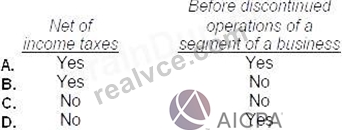
- A. Option A
- B. Option B
- C. Option C
- D. Option D
Answer: B
Explanation:
Choice "b" is correct, Yes - No. An extraordinary item should be reported separately on the income
statement as a component of income:
Yes - net of income taxes.
No - after (not before) "discontinued operations of a segment of a business."
NEW QUESTION 88
Terra Co.'s total revenues from its three operating segments were as follows:
Which operating segment(s) is (are) deemed to be reportable segments?
- A. Lion, Monk, and Nevi.
- B. Lion only.
- C. None.
- D. Lion and Monk only.
Answer: A
Explanation:
Choice "d" is correct. A reportable operating segment is one having 10% of all revenue, including revenue
from unaffiliated sales and from intersegment sales:
Lion's revenue percentage is 66.7% [$100,000/150,000].
Monk's revenue percentage is 17.3% [$26,000/150,000].
Nevi's revenue percentage is 16% [$24,000/150,000].
Thus, all three segments meet the 10% of total revenues test and are reportable as operating segments.
SFAS 14 para. 10 and 15 as amended by SFAS 131
Choice "a" is incorrect. All segments with revenue percentages exceeding 10% of total revenues are
reportable operating segments.
Choice "b" is incorrect. Lion is not the only segment with revenue percentages exceeding 10% of total
revenues.
Choice "c" is incorrect. Nevi has a revenue percentage exceeding 10% of total revenues.
NEW QUESTION 89
In Yew Co.'s 1992 annual report, Yew described its social awareness expenditures during the year as
follows:
"The Company contributed $250,000 in cash to youth and educational programs. The Company also gave
$ 140,000 to health and human-service organizations, of which $80,000 was contributed by employees
through payroll deductions. In addition, consistent with the Company's commitment to the environment,
the Company spent $100,000 to redesign product packaging."
What amount of the above should be included in Yew's income statement as charitable contributions
expense?
- A. $310,000
- B. $490,000
- C. $410,000
- D. $390,000
Answer: A
Explanation:
Choice "a" is correct. Charitable contributions include amounts the company gave to recognized charities.
This includes:
Note: Of the $140,000, employees gave $80,000, and the company $60,000. Redesigning packaging is
not a contribution to a charity.
Choice "b" is incorrect. The company gave only $60,000 of the $140,000. Employees gave $80,000.
Choice "c" is incorrect. Redesigning packaging is not a contribution to a charity.
Choice "d" is incorrect. The company gave only $60,000 of the $140,000. Employees gave $80,000.
Redesigning packaging is not a contribution to a charity.
NEW QUESTION 90
A change from the cost approach to the market approach of measuring fair value is considered to be what
type of accounting change?
- A. Error correction.
- B. Change in valuation technique.
- C. Change in accounting principle.
- D. Change in accounting estimate.
Answer: D
Explanation:
Choice "a" is correct. A change in the valuation technique used to measure fair value is a change in
accounting estimate. Choice "b" is incorrect. Per SFAS No. 157, a change in valuation technique is a
change in accounting estimate, not a change in accounting principal. Choice "c" is incorrect. Although a
change from the cost approach to the market approach is a change in valuation technique, a change in
valuation technique is not defined as a type of accounting change, but instead falls into the category of
changes in accounting estimate. Choice "d" is incorrect. Both the market approach and the cost approach
are acceptable methods of measuring fair value per SFAS No. 157; therefore, switching between these
methods is not the correction of an error. Additionally, an error correction is not a type of accounting
change.
NEW QUESTION 91
......
FAR Dumps for Pass Guaranteed - Pass FAR Exam: https://testking.realvce.com/FAR-VCE-file.html