TS: Windows Server 2008 R2, Server Virtualization VCE 2026 Guaranteed Clear Exam Success
RealVCE offers you valid VCE files for 70-659 which you will need to clear the Microsoft TS: Windows Server 2008 R2, Server Virtualization exam, the VCE files we sell, has got supreme quality and helps you to clear real exam surely with only one time attempt. We provide you a 100% pass guaranteed success and build your confidence to be 70-659: TS: Windows Server 2008 R2, Server Virtualization certified professional and have the credentials you need to be the outstanding performance with our 70-659 real questions. Our products are surely guaranteed to assist all candidates pass exams. We also guarantee your money safety. If you fail real exam with our TS: Windows Server 2008 R2, Server Virtualization dumps VCE and send us your unqualified score, we will full refund to you with two working days with any doubt. We are confident with our high-quality 70-659 real questions.
Get Complete and Professional premium VCE file
At present you get the new version of TS: Windows Server 2008 R2, Server Virtualization VCE 2026 available in the printable format because we know the worth of print-outs and how easy it is to learn when you log in our website on computer and download hard-copy of 70-659 real questions available. Trust us, your preparation for the real exam will get a whole lot convenience so that you have that added advantage, you can learn TS: Windows Server 2008 R2, Server Virtualization exam VCE on your laptop whenever you want for free.
Humanized and easy to remember software and test engine for real exam
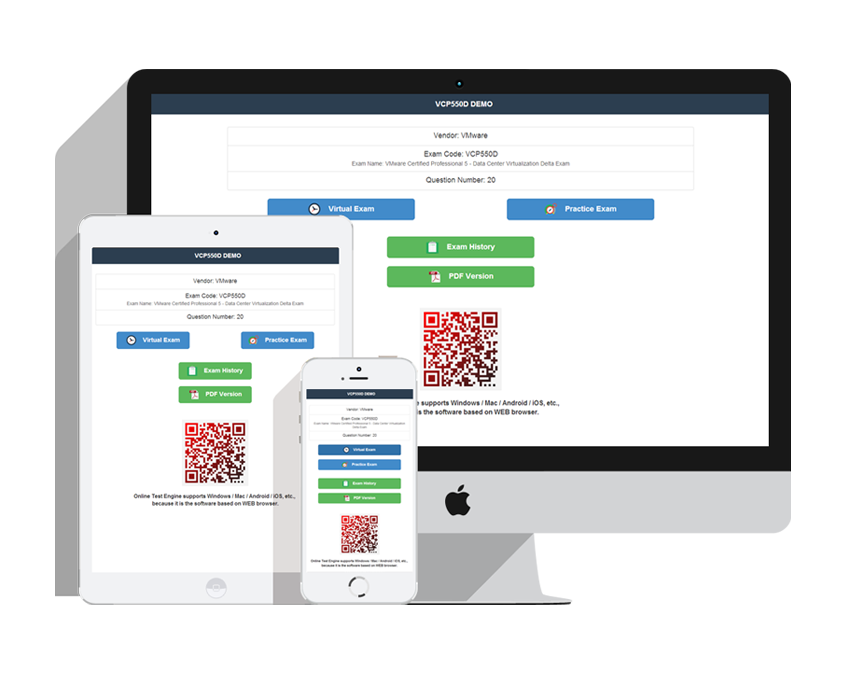
In addition to premium VCE file 2026 for TS: Windows Server 2008 R2, Server Virtualization exam, we release software and test engine version which may be more humanized, easy to remember and boosting your confidence. The software version of 70-659 real questions is used on computer and laptop. The APP test engine is used on all kinds of electronic products including computer, laptop and other products. Both of the two versions of 70-659:TS: Windows Server 2008 R2, Server Virtualization VCE 2026 can simulate the real exam scene, set up limited-time test, mark scores, point out mistakes and remind you practicing every time.
Many IT elites are busy in working daytime and preparing exams night. Although they may feel laborious, they don't believe Microsoft 70-659 real questions. All the wit in the world is not in one head. Maybe you have outstanding performance in work, professionals be professionals. TS: Windows Server 2008 R2, Server Virtualization VCE 2026 is the latest, valid and accurate study material for candidates who are eager to clear exams. You can actually grasp the limited time to do as much interesting and effective things you like as possible. 70-659: TS: Windows Server 2008 R2, Server Virtualization real questions are high value with competitive price products.

Ask us any-time if you are interested in our TS: Windows Server 2008 R2, Server Virtualization VCE 2026
RealVCE provide you excellent online support which is available for candidates 24/7 if you have problem about our 70-659 real questions, and we will answer your query in two hours mostly. Our service rule is that all emails and contacts will be replied as soon as possible. If you want to purchase our 70-659: TS: Windows Server 2008 R2, Server Virtualization VCE 2026, you will receive our products immediately after your payment.
All we are not only offering you the best 70-659 real questions and answers but also the foremost customer service. Please rest assured that your money and information will be strictly protected and safe with our 70-659: TS: Windows Server 2008 R2, Server Virtualization VCE 2026. Choosing our products will be your cleaver action for clearing Microsoft MCTS real exam.
Instant Download: Our system will send you the 70-659 braindumps file you purchase in mailbox in a minute after payment. (If not received within 12 hours, please contact us. Note: don't forget to check your spam.)
Microsoft 70-659 Exam Syllabus Topics:
| Section | Weight | Objectives |
|---|---|---|
| Topic 1: Monitoring and Maintaining Virtualization Infrastructure | 15% | - Monitor performance and health - Implement disaster recovery - Update and patch management - Backup and restore virtual machines |
| Topic 2: Installing and Configuring Hyper-V | 25% | - Configure host settings and hardware requirements - Install Hyper-V role and Hyper-V Server - Configure remote management and firewall rules - Configure virtual networks and VLAN settings |
| Topic 3: Managing Virtual Machine Environments | 25% | - Configure migration: quick, live, and storage migration - Manage multi-platform virtualization hosts - Use System Center Virtual Machine Manager (VMM) - Implement Cluster Shared Volumes (CSV) |
| Topic 4: Creating and Configuring Virtual Machines | 25% | - Configure VM settings, storage, and memory - Configure VM availability and resource allocation - Create, import, export, and clone virtual machines - Manage virtual hard disks and snapshots |
| Topic 5: Configuring VMM Self-Service Portal and Automation | 10% | - Automate tasks using PowerShell - Deploy and configure Self-Service Portal - Delegate permissions and roles |
Microsoft TS: Windows Server 2008 R2, Server Virtualization Sample Questions:
1. A company has a Windows Server 2008 R2 Hyper-V server environment. The environment is managed with Microsoft System Center Virtual Machine Manager (VMM) 2008 R2. There is an existing web server farm that uses Windows Network Load Balancing (NLB).
You need to add a virtual machine (VM) to the web server farm while meeting the following requirements:
-The operating system must be deployed to the VM by using PXE and System Center Configuration Manager (ConfigMgr) 2007 R2.
-After deployment, the VM must converge with the existing NLB cluster.
-CPU utilization must be minimized.
What should you do?
A) Add a disk drive to the VM by using the iscsicli.exe command line tool.
B) Install the server application on a physical server.
C) Add an emulated network adapter to the VM and select the Enable virtual network optimizations option.
D) Add a synthetic network adapter to the VM and select the Enable spoofing of MAC addresses option.
E) Add a disk drive to the VM by using the Add clusterSharedVolume PowerShell cmdlet.
F) Assign 1 GB of startup RAM and 4 GB of maximum RAM to the VM.
G) Assign 4 GB of static memory to the VM.
H) Install the server application in a VM with the latest supported integration components.
I) Assign 1 GB of startup RAM and 8 GB of maximum RAM to the VM.
J) Add an emulated network adapter to the VM and select the Enable spoofing of MAC addresses option.
K) Add a synthetic network adapter to the VM and select the Enable virtual network optimizations option.
L) Add a disk drive to the VM by using the New-VirtualDiskDrive PowerShell cmdlet.
2. You use Hyper-V server 2008 R2 and failover clustering to host several virtual machines (VMs). You plan to perform a Volume Shadow Copy (VSS) backup of a Cluster Shared Volume (CSV).
You need to ensure that resources can continue to use the CSV during the VSS backup.
What should you do?
A) Turn on maintenance mode for the CSV.
B) Configure your VSS-aware backup utility as a generic application in failover clustering.
C) Use Failover Cluster Manager to remove dependences from your disk resources.
D) Turn on redirected access for the CSV.
3. You create a snapshot of a running virtual machine (VM) before applying a new service pack for the operating system.
You receive an alert that the host is running low on disk space on the volume where you took a snapshot of the VM.
You need to free up disk space on the volume while ensuring that future restarts of the VM are successful.
Which three actions should you perform in sequence? (To answer, move the appropriate actions from the list of actions to the answer area, and arrange them in the correct order.)
Select and Place:
4. You use Microsoft System Center Virtual Machine Manager (VMM) 2008 R2 to create and manage virtual
machines (VMs).
You attempt to create the first VM on a Hyper-V host by using Windows PowerShell.
You receive an error message stating that the New-VM PowerShell cmdlet is not recognized.
You need to be able to create VMs by using PowerShell.
What should you do?
A) Run the Create-VM -Name "VM01" -VirtualHardDisk $VHD -VMHost $VMHost -Path "C:\MyVMs" PowerShell cmdlet.
B) In PowerShell, run the Add-PSSnapin Microsoft.SystemCenter.VirtualMachineManager cmdlet.
C) Enable the Windows PowerShell Integrated Scripting Environment feature.
D) Install the VMM Self-Service Portal.
5. A company uses Microsoft System Center Virtual Machine Manager (VMM) 2008 R2 to manage their Hyper-V environment.
A VMM hardware profile is required for the new SQL Server 2008 R2 Enterprise VMs. Based on company policy, VMs running SQL Server 2008 R2 Enterprise must use Dynamic Memory and the memory allocation for the VMs must be set to high.
You need to configure a VMM hardware profile so that the memory allocation priority is set to high.
How should you configure the hardware profile? (To answer, select the appropriate node in the answer area.)
Hot Area:
Solutions:
| Question # 1 Answer: J | Question # 2 Answer: D | Question # 3 Answer: Only visible for members | Question # 4 Answer: B | Question # 5 Answer: Only visible for members |


 Sherry
 Meredith
 Evelyn
 Sigrid
  Muriel
  Josephine
  Susan
Susan  Henry
Henry  Paul
Paul  Dale
Dale  Bing
Bing  Colby
Colby  Hilda
Hilda  Lydia
Lydia  Hazel
Hazel  Sophia
  James
James  Eric
Eric